"But only an act of true love can thaw a frozen heart." -- Grand Pabbie in Frozen dir. Chris Buck and Jennifer Lee
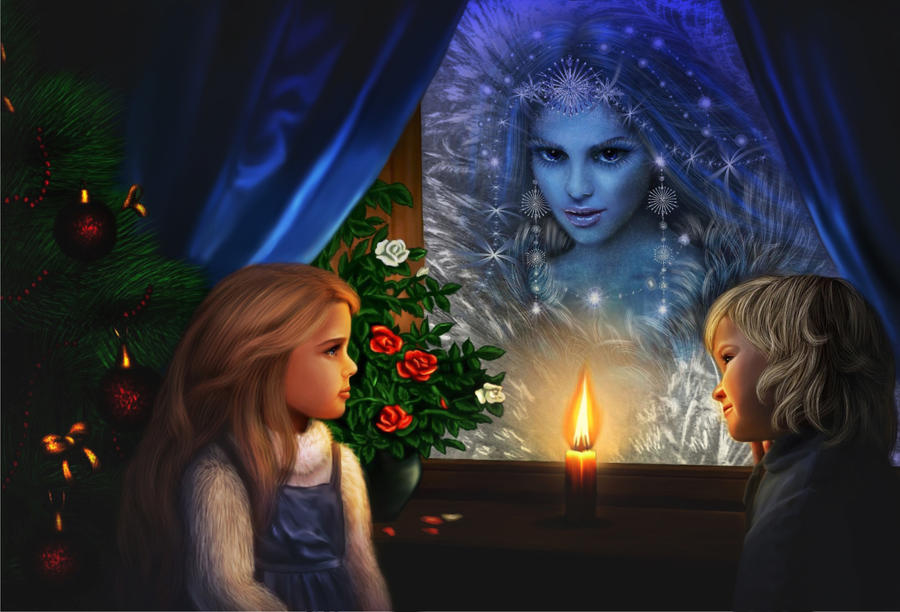 |
| "Often at midnight she flies through the streets of the town, and looks in at the windows, then the ice freezes on the panes into wonderful shapes, that look like flowers and castles." Snow Queen (2009) by lilok-lilok |
About the Author
Hans Christian Andersen was born on April 2, 1805, in Odense, Denmark. His mother was a laundrywoman, and his father was a shoemaker. Despite being poor, Hans' parents loved and spoiled him, encouraging him to use his imagination. Andersen grew up loving song and dance. Having a tall and bony figure made look a bit awkward, but Andersen least cared about his appearance.
When Andersen was eleven years old, his father died of tuberculosis. Three years later, Andersen left for Copenhagen to become a stage artist at the Royal Theatre. Although he was rejected, a director named Jonas Collin became Andersen's patron, providing the future fairytale writer a scholarship to obtain basic education.
After seven hard years of studying, Andersen graduated from university in 1828.
Today, Hans Christian Andersen is famous for his fairy tales. Written between 1835 and 1850, Andersen's stories include The Ugly Duckling, The Little Mermaid, The Wild Swans, The Princess and the Pea, The Little Match Girl, Thumbelina, The Emperor's New Clothes, The Steadfast Tin Soldier, The Nightingale, The Red Shoes, The Tinderbox, and The Snow Queen.
Dark and fantastic, Andersen's fairy tales had made him a household name among fairy tale fans, his stories read along those by Charles Perrault, the Brothers Grimm, Joseph Jacobs, and Gabrielle Suzanne Barbot de Villeneuve.
Hans Christian Andersen died on August 4, 1875, but people around the world still read his fairy tales, many of which continue to be adapted for the stage and screen.
Summary of The Snow Queen
😈First Story: Which Describes a Looking-Glass and the Broken Fragments🪞
In Inferno, the Devil makes a mirror that shows good and beautiful things as evil and ugly. The Devil and his demonic minions take the mirror around the world, enjoying the shocked and dismayed faces of the good people who look into the glass.
The Devil then decides to use the mirror to fool God and His angels. The demons carry the mirror up to Paradise, but they laugh about their plot so much that they drop it.
The mirror crashes on the Earth's surface, the glass shattering into billions of pieces, some as small as grains of sand. The glass fragments are blown all over the world, getting into people's eyes and hearts. Those who get fragments in their eyes see nothing but the evil and ugly sides of people and things, while those who get fragments in their hearts become as cold as ice.
🫛👦🏻👧🏼🌹Second Story: A Little Boy and a Little Girl🧊❄️👸🏼🐝
In one big city live two children: a girl named Gerda and a boy named Kay. The two children are best friends and love each other dearly. Gerda and Kay live next door to each other, the roofs of their houses adjoining. Kay's and Gerda's families respectively grow sweet-peas and roses in window boxes on the gutters, the two plants forming an arch. Gerda and Kay have their own rooftop garden where they play together.
On one snowy night, Kay's grandmother tells him and Gerda about the Snow Queen. A woman made out of ice, the Snow Queen leads the snow bees, snowflakes that look like bees, and is said to be seen wherever it snows the most. When Gerda becomes scared of seeing the Snow Queen, Kay promises to protect her by melting the Snow Queen by the stove.
That same night after Gerda goes home, Kay is shocked to see the Snow Queen herself through his bedroom window. The Queen beckons Kay to come with her, but the boy instead hides under his blanket, shivering in fear.
The seasons pass and Gerda and Kay continue to be friends. But on one pleasant day in summer, two fragments of the Devil's mirror pierce one of Kay's eyes and his heart, turning him into a naughty boy. Kay stops playing with Gerda, destroys their rooftop garden, and makes fun of his grandmother.
Come the following winter, Kay sees everyone else as ugly and evil, with the only things he considers good and beautiful to be the snowflakes he inspects with a magnifying glass. Kay goes with his sledge to play in the market square. The boy sees a woman wearing a white fur-coat and riding a white sleigh carriage. Kay hitches his sledge to the woman in white's sleigh, and gets taken for a ride.
The woman drives her sleigh at incredible speed, taking the boy with her. Outside the city, the woman reveals herself to be the Snow Queen and beckons Kay to sit beside her. The boy sits next to the Snow Queen and she kisses him twice: once to make him ignore the cold, and again to make him forget about Gerda and their families. The Snow Queen refuses to give Kay a third kiss because it would kill him and takes him to her kingdom.
🧙🏼♀️Third Story: The Flower Garden of the Woman Who Could Conjure🌹
Unaware that he has been kidnapped by the Snow Queen, Kay's family and neighbours organise a search party. Unable to find him, the people believe the boy has drowned in the cold river. Gerda's grandmother tries to comfort her, but the girl believes that Kay is still alive and decides to look for him herself.
The following summer, Gerda goes to the same river where Kay is said to have drowned in. Gerda gives the river her red shoes, and it tells her that Kay did not drown. Gerda climbs into a boat and the river carries her away.
An old Witch sees Gerda and pulls her ashore with her long crook. The Witch takes Gerda into her house which is surrounded by a flower garden where summer is eternal. Although she is not wicked, the Witch wants Gerda to live with her forever. The Witch feeds Gerda enchanted cherries and fixes her hair with a magical comb, erasing the girl's memories of Kay and makes all the roses in the flower garden sink underground.
Time passes, and while playing in the garden, Gerda sees a rose in the Witch's hat and she remembers Kay. Crying over her missing friend, Gerda's tears warm the earth, making the roses reappear. The roses tell her that of all the dead people buried underground, Kay is not among them. Gerda escapes the garden and discovers it is already autumn.
🐦⬛🤴🏼Fourth Story: The Prince and the Princess👸🏻🐦⬛
Gerda meets a crow who claims that Kay is married to a Princess and lives in her palace. Aided by the crow's mate, Gerda travels to the palace and enters the royal couple's bedroom. But Gerda discovers that while he looks like him, the Prince is not Kay.
The Prince and the Princess are at first startled by Gerda trespassing into their home, but pity her when she tells them her story.
The Prince and the Princess give Gerda warm clothes to wear and a coach to ride on before sending her on her way.
👧🏾Fifth Story: Little Robber-Girl🦌
While travelling through the woods, a gang of robbers steals the coach and brings Gerda to its castle.
At the castle, the old robber-woman wants to eat Gerda, but is prevented by her daughter. Gerda becomes friends with the robber-girl and a captive reindeer named Bae. After Gerda shares her story, the robber-girl's pet doves say they had seen the Snow Queen kidnap Kay and whisk him away in the direction of Lapland. Bae tells Gerda he knows where Lapland because it is his home.
As the winter snow falls and the northern lights gleam across the night sky, the robber-girl frees Gerda and Bae, and the two travel north to Lapland.
🐟Sixth Story: The Lapland Woman and the Finland Woman🧖🏼♀️
Gerda and Bae make it to Lapland where a local woman offers them shelter. Upon hearing their story, the Lapland Woman tells Gerda and Bae that they must travel to Finland where the Snow Queen lives. The Lapland Woman then writes on a dried codfish directions to the house of a Finland Woman who might know the way to the Snow Queen's kingdom.
After resting at the Lapland Woman's house, she sends Gerda and Bae on their way. Following the directions on the codfish, Gerda and Kay arrive at the Finland Woman's house.
Upon hearing Gerda's story, the Finland Woman tells the girl that Kay is indeed in the Snow Queen's kingdom and cursed by the Devil's mirror shards, explaining his sudden change in personality. The Finland Woman tells Gerda which way to go before sending her away, and tells Bae that the girl's kind heart is the key to bringing Kay home.
❄️👸🏼Seventh Story: Of the Palace of the Snow Queen and What Happened There At Last👩🏼👨🏻
In the middle of a frozen lake called the Mirror of Reason sits the Snow Queen. It is in her palace of ice and snow where the Snow Queen has been keeping Kay prisoner.
Still cursed by the Devil's mirror, Kay has been trying to spell a certain word by using pieces of ice. The Snow Queen had promised Kay that she would free him and give him a pair of ice skates once he solves the puzzle. One day, the Queen leaves her palace to run an errand.
Gerda arrives at the Snow Queen's palace, but is stopped by the snow creatures guarding it. Gerda cites the Lord's Prayer, her breath transforming into an army of angels that fend off the beasts, enabling her to the enter the palace.
Gerda finds Kay alone and frozen. Seeing her friend alive, Gerda hugs and kisses Kay, shedding tears of joy that melt the mirror fragment in the boy's heart. Warmed up for the first time in years, Kay cries out the mirror fragment in his eye. Gerda's act of love breaks the spell, making Kay remember his best friend.
Reunited at last, Gerda and Kay dance around, causing the icy puzzle pieces to spell out "eternity," the word the Snow Queen had commanded the boy to spell.
Gerda leads Kay back home from the Snow Queen's kingdom, encountering the people and animals the brave girl had befriended during her adventure.
By the time Gerda and Kay return home to the city, the two best friends have grown up and it is summertime once again.
Kay's grandmother ends the story by citing Matthew 18:3:
"Amen, I say to you, unless you become like little children again, you shall not enter the kingdom of heaven."
Symbols
Mirror🪞
The mirror is a recurrent symbol in many fairy tales, most famously in Snow White and the Seven Dwarfs and Beauty and the Beast.
In The Snow Queen, the reflecting surface of the Devil's mirror can represent illusions that corrupt the soul (Lederer 1986, 6-7). The scene where the accursed mirror shatters on Earth's surface alludes to the fall of Lucifer and his fellow rebellious angels, a passage made famous in John Milton's poem Paradise Lost (Heiner, 2021).
Roses🌹
Roses appear in many of Andersen's writing, whether in titles (A Rose from Homer's Grave, The Rose Elf, The World's Most Beautiful Rose) and in the environments of Andersen's characters (in The Snow Queen, Little Ida's Flowers, and Inchelina).
The roses in Gerda and Kay's garden symbolise passion and desire, but it is also, in the Christian imagery, the flower representing the Virgin Mary, the sacrificial power of love, the promise of eternal life in Paradise, innocence, and royalty (Heiner, 2021).
River🌊
The river is a symbol of life and fate, but Andersen found probably the inspiration for this story in his own past. Once, during his father's sickness, little Hans Christian was sent from his mother to a local wise woman, to ask about the man's destiny. The woman told him that if his father was going to die he would have met his ghost by the river (TS, 17-18).
Red👠
The colour red symbolises menstruation, and the double standard of awoken sexuality. Thus, by throwing her red shoes away, Gerda decides to stay pure (Zipes: 1993, 24; Lederer: 1986, 34-38).
Tears😭
The tears Gerda sheds symbolise her love for Kay, calling back roses from underground and breaking the Devil's spell (Heiner, 2021).
Crows🐦⬛
In Norse mythology, the god Odin has two ravens named Huginn (Thought) and Muninn (Memory) (Lederer: 1986, 47) .
Crows and ravens are generally associated with dreams, as shown in Edgar Allan Poe's poem The Raven.
The two crows in The Snow Queen suggest that the tale can be read as a dream, in which the Princess and the Prince are imaginary versions of Gerda and Kay (Heiner, 2021).
Doves🕊️
Pigeons or doves are the birds of love (Heiner, 2021).
Reindeer🦌
In the shamanistic tradition, the reindeer is often the animal mother of the shaman, which leads and helps him in the realm of the spirits (Eliade, 1951).
Northern Lights

Aurora borealis: From the Merriam Webster Dictionary: "an aurora that occurs in Earth's northern hemisphere; called also northern lights".
For centuries, the people of the north had seen in the wonderful lights more than a natural extravagance: Inuit people thought that they were the torches of the dead, which indicated the path to the otherworld. In Medieval Europe, they were thought to be the reflections and the breath of heavenly warriors. The Finnish name for the northern lights is "revontulet" which means "fox fires": the Finns in fact believed that a supernatural fox was sweeping the arctic snows with its tail, causing sparks of light that shone in the sky.
Andersen himself gives another poetical explanation for them in the tale The Phoenix (Heiner, 2021).
Ice and Snow🧊❄️
While ice and snow are traditionally associated with winter wonderlands, they can also be symbols of fear and death due to how low temperatures could get during the coldest season of the year.
In The True Story of My Life, Andersen tells about his first encounter with a woman made of ice. Before he died, Anderson's sick father once stood at the frosted window and indicated "a figure as that of a maiden with outstretched arms. 'She is come to fetch me,' he said, in jest" (TS, 17-18; Lederer: 1986, 28).
The Franks write: "As the modern Danish critic Villy Sorensen has observed, Andersen saw the snow queen's icy world as the proper home for someone whose heart has been replaced by chilly reason--a category in which Andersen certainly placed many of his contemporaries" (169) (Heiner, 2021).
Themes
Adventure🌍
Gerda's adventures take her to faraway lands, alluding to Andersen's fascination by travel to foreign countries.
When done right, an author creates for the reader a map of real or imaginary places they could explore from the comfort of the bedroom (Shmoop, 2008).
Religion⛪
Like the majority of his Danish compatriots at the time, Andersen was also into Christianity. This devoutness manifests in the writer's stories, including The Snow Queen, The Red Shoes, and The World's Most Beautiful Rose (Shmoop, 2008).
Before she could enter the Snow Queen's palace, Gerda cites The Lord's Prayer, a well-known prayer that calls for God to bless His children with their needs, to forgive them for their sins, and to guide them away from evil.
Gerda's search for her missing friend even alludes to Jesus' Parable of the Lost Sheep. Just as the shepherd in Jesus' parable leaves his flock to find the missing sheep, Gerda leaves behind her family and home to find and rescue Kay.
The message of the Parable of the Lost Sheep is redemption. Just as Jesus redeems sinners, Gerda does a similar action when she breaks the curse Kay is under.
At the very ending of the fairy tale, Kay's grandmother cites Matthew 18:3, a Biblical verse that says only those who are humble and dependent on God can enter Paradise.
Love❤️
While acts of true love are usually the tools needed to lift fairy tale curses, Hans Christian Andersen himself never got a happy ever after.
Per Andersen's letters and diaries, the Danish writer's relationships were one-sided.
It is said that the seed for The Snow Queen was sown when Andersen fell in love with Swedish opera singer Jenny Lind. Sadly for Andersen, his heart got broken when Jenny turned him down and insisted that they remain friends. Even though Jenny and Andersen remained close, the rejection still hurt the writer, prompting him to create the cold-hearted Snow Queen. As a counterpart, Andersen included the fiery Devil in what would become his longest fairy tale, which he eventually published in 1844.
Because he desired for his own true love, Andersen's portrayals of love are creative and diverse to say the least. In his stories, Andersen wrote about everything from romantic love to platonic love, familial love, spiritual love, and more.
All these forms of love cause some of Andersen's characters to suffer, but also be inspired to accomplish great deeds. Furthermore, numerous obstacles are shown to get in the way of love, such as class differences, evil people's desires, and even God's will. So, even if his actual experiences of love were pretty one-sided, Andersen's tales make him seem like a bona fide love expert (Shmoop, 2008).
The Snow Queen in Popular Culture
Since its publication in 1844, The Snow Queen has been one of Andersen's most popular fairy tales. For decades, The Snow Queen has been depicted in art and adapted multiple times for the stage and screen.
In 2013, Disney loosely adapted The Snow Queen into Frozen, an animated fantasy adventure musical film directed by Chris Buck and Jennifer Lee, and featuring music composed by Christophe Beck and songs by Robert Lopez and Kristen Anderson-Lopez.
Disney's Frozen takes place in Arendelle, a kingdom that's home to Princess Anna (Kristen Bell, Veronica Mars) and her older sister, Queen Elsa (Idina Menzel, Wicked), who can conjure ice and snow.
When Elsa runs away, trapping her own kingdom in an eternal winter, Anna goes on an adventure to bring her home and lift the curse, accompanied by the iceman Kristoff (Jonathan Groff, Glee) his reindeer friend Sven, and the summer-loving snowman Olaf (Josh Gad, The Book of Mormon).
 |
| Elsa: "The cold never bothered me anyway." |
Through trial and error, an act of true of love is what's needed to bring back summer and repair the bond between the two royal sisters.
When it premiered on November 27, 2013, Disney's Frozen was a box office hit, becoming one of the highest-grossing animated films of all time, and winning the 2014 Academy Awards for Best Animated Feature Film and Best Original Song.
Whether or not Frozen has made people interested in reading The Snow Queen is still debatable. But what is clear is that an act of true love is all it takes to have a happy ending.
When it premiered on November 27, 2013, Disney's Frozen was a box office hit, becoming one of the highest-grossing animated films of all time, and winning the 2014 Academy Awards for Best Animated Feature Film and Best Original Song.
Whether or not Frozen has made people interested in reading The Snow Queen is still debatable. But what is clear is that an act of true love is all it takes to have a happy ending.
References
- Andersen, H. C. (2018). Dark Tales: The Snow Queen: A Graphic Novel. Canterbury Classics.
- Buck, C. & Lee, J. (Directors). (2013). Frozen [Film]. Walt Disney Pictures.
- DisneyMusicVEVO. (2014, February 11). Idina Menzel - Let It Go (from "Frozen") (Sing-Along Version) [Video]. YouTube. https://www.youtube.com/watch?v=Dr57W6R1qVE
- Hans Christian Andersen. (2023). Famous Authors. https://www.famousauthors.org/hans-christian-andersen
- Heiner, H. A. (2021). Snow Queen Annotations. SurLaLune Fairy Tales. https://www.surlalunefairytales.com/s-z/snow-queen/snow-queen-annotations.html
- lilok-lilok. (2009, November 19). Snow Queen [Image]. DeviantArt. https://www.deviantart.com/lilok-lilok/art/Snow-Queen-144097268
- Shmoop Editorial Team. (2008, November 11). Andersen's Fairy Tales Love. Shmoop. https://www.shmoop.com/study-guides/literature/hans-christian-andersen/themes/love
- Shmoop Editorial Team. Shmoop Editorial Team. (2008, November 11). Andersen's Fairy Tales Roses. Shmoop. https://www.shmoop.com/study-guides/literature/hans-christian-andersen/analysis/roses
- Shmoop Editorial Team. Shmoop Editorial Team. (2008, November 11). Andersen's Fairy Tales Setting. Shmoop. https://www.shmoop.com/study-guides/literature/hans-christian-andersen/analysis/setting